
Table of Contents
- Why Clinical Data Matters for Light Therapy Devices
- Red Light Therapy Irradiance Explained: The Foundation of Efficacy
- Understanding Photometric Reports for LED Devices
- Clinical Trial vs Marketing Claim for Wellness Tech
- Calculating Dosage: Fluence, Treatment Time, and the Inverse Square Law
- Red Flags: How to Spot Deceptive Clinical Claims
- Putting It All Together: Your Clinical Data Checklist
- Frequently Asked Questions
Last Updated: October 2, 2026
Why Clinical Data Matters for Light Therapy Devices
When you're considering a light therapy device, marketing claims are everywhere. One brand promises "cellular rejuvenation." Another touts "clinically proven results." But what does that actually mean?

Understanding clinical data separates devices that deliver results from those that don't. Learning how to read clinical data for light therapy devices transforms you from a passive consumer into someone who can evaluate claims with confidence.
Clinical data reveals whether a device produces the wavelengths it claims, whether those wavelengths reach the promised tissue depth, and whether independent testing backs up the marketing.
Red Light Therapy Irradiance Explained: The Foundation of Efficacy
Irradiance is the power of light hitting your skin per unit area, measured in milliwatts per square centimeter (mW/cm²).
A device emitting red light at the right wavelength but low irradiance won't penetrate deep enough to trigger results.
Reputable devices state irradiance at a specific distance (typically 6 inches or 15 centimeters).
Therapeutic applications typically require 0.5 to 1.0 mW/cm² for skin health and cellular support.
Power Density and Wavelength: What the Numbers Actually Mean
Power density and irradiance are the same thing, they describe how concentrated the light output is.
Wavelength, measured in nanometers (nm), describes light color and penetration depth.
Both irradiance and wavelength matter: powerful light at the wrong wavelength won't work, and the perfect wavelength at low power won't deliver results.
Manufacturers should provide spectral data, a graph showing exact wavelengths and energy distribution.
Therapeutic Wavelengths: 660nm vs 850nm and Beyond
Red light at 660 nm is the most studied wavelength for skin health and collagen production, penetrating 8-10 millimeters.
Near-infrared at 850 nm penetrates up to 40 millimeters, reaching muscle and bone. It supports muscle recovery and systemic cellular function. Full-body panels like the PurRed™ Advanced Panel use 850 nm for comprehensive wellness support.

Some devices combine both wavelengths, like the Illuminate Red V2, allowing simultaneous targeting of surface skin and deeper tissues.
Clinical evidence differs by wavelength. For skin rejuvenation, seek 660 nm studies; for muscle recovery, seek 850 nm data. Wrong wavelength won't deliver results regardless of power.
Understanding Photometric Reports for LED Devices
A photometric report is a technical document that measures and verifies a device's light output. It's the closest thing to an independent audit of what a device actually produces.
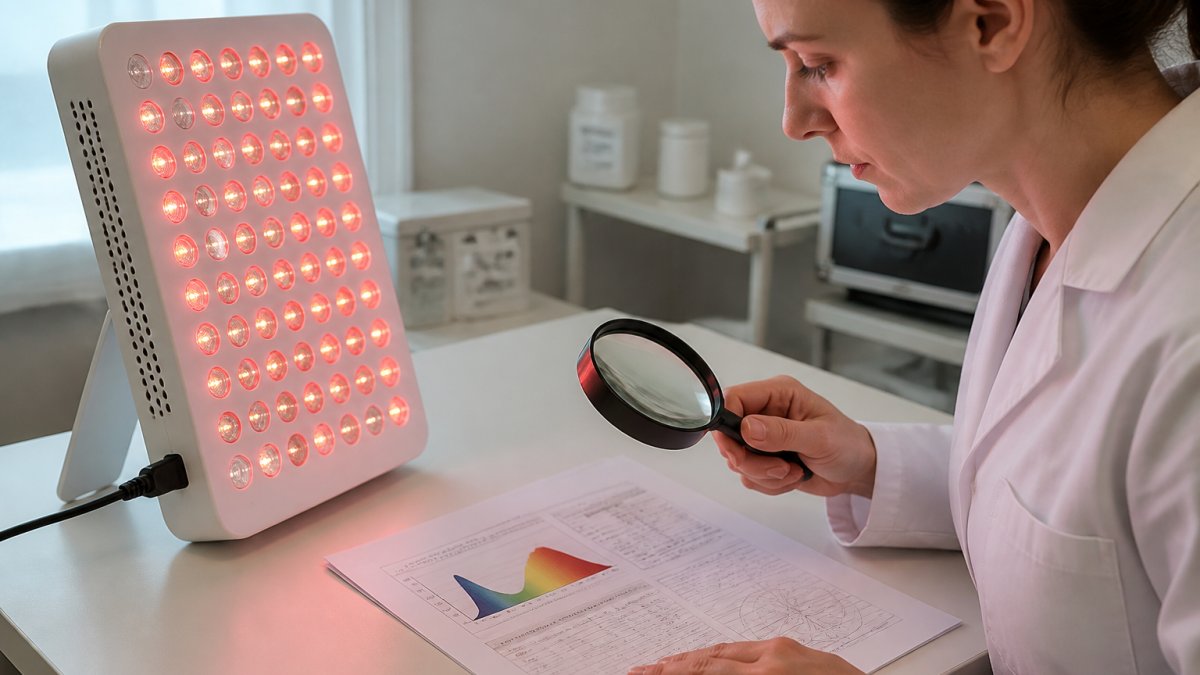
Reputable manufacturers commission photometric reports from third-party labs, including irradiance, spectral data, beam angle, and optical output. Ask for this document before buying.
If a manufacturer won't share the photometric report, that's telling. Legitimate clinical data is a selling point, not a secret.
Decoding Spectral Data and Optical Output Specifications
Spectral data shows you the exact distribution of light across wavelengths.
Look for a narrow, well-defined peak at your target wavelength (660 nm or 850 nm).
Optical output measures total light energy (watts), different from irradiance (intensity per unit area).
The report should specify beam angle. Narrow beams (10-20°) concentrate light for higher irradiance; wide beams (60-90°) cover more area at lower irradiance per cm².
Evaluating Build Quality, LED Chips, and Heat Dissipation
LED chip quality determines reliability. Premium devices use medical-grade LEDs maintaining consistent output; cheap devices use consumer-grade LEDs that degrade faster.
Ask the manufacturer about LED chips, operating hours, and expected lifespan. A 50,000-hour device outlasts a 10,000-hour one.
Heat dissipation matters: poor heat management causes wavelength drift and shortened lifespan. Look for aluminum heat sinks or active cooling. Premium devices like the Illuminate Red V2 prioritize heat management.

Check for certifications. FDA clearance for light therapy devices is meaningful, it means the device has been tested and meets safety standards for intended use.
Clinical Trial vs Marketing Claim for Wellness Tech
Here's where many buyers go wrong: they confuse marketing language with clinical evidence.
A marketing claim might say "reduces fine lines by up to 30%." But where does that number come from, peer-reviewed trial, manufacturer study, or testimonials?
Clinical trials use control groups, objective measurement, peer-reviewed publication, and independent verification. Marketing claims prioritize persuasion over accuracy.
VISO - FDA Certified Red Light Therapy Mask →
Peer-Reviewed Evidence vs Manufacturer Marketing Data
Peer-reviewed studies are vetted by independent experts, with scrutinized methodology and reproducible results, the gold standard for clinical evidence.
Manufacturer-funded studies have inherent conflicts of interest.
Testimonials and before-and-after photos show user experience but aren't clinical evidence. Results are influenced by expectation, placebo effect, and lifestyle factors.
Separate three layers: peer-reviewed research (strongest), manufacturer testing, and customer reports (useful context, not proof).
Standardized Testing Protocols and FDA Clearance
FDA clearance means the device has been tested for safety and effectiveness for specific intended uses.
Not all devices are FDA-cleared. General wellness claims don't require approval; therapeutic claims do.
Standardized testing protocols exist for measuring light output, safety, and performance. Look for devices tested according to these standards.
FDA clearance is a baseline for safety and efficacy, not a guarantee of superior results.
Calculating Dosage: Fluence, Treatment Time, and the Inverse Square Law
Fluence is the total light energy delivered to your skin over a treatment session, measured in joules per square centimeter (J/cm²).
The formula is simple: Fluence = Irradiance × Time
If a device delivers 0.5 mW/cm² for 20 minutes, you receive 600 J/cm².
Clinical research often specifies the fluence used in studies.
The inverse square law governs how irradiance changes with distance.
If a manufacturer claims 100 mW/cm² at 6 inches, moving to 12 inches reduces irradiance to 25 mW/cm².
Red Flags: How to Spot Deceptive Clinical Claims
Several warning signs suggest a device's clinical claims are overstated or misleading.
Missing specifications. Missing irradiance, wavelength, or spectral data is a red flag.
Exaggerated before-and-after photos. Professional photography, lighting, makeup, and angles can make dramatic differences.
Unsubstantiated percentage claims. "Reduces wrinkles by 40%." "Increases collagen by 30%." Where do these numbers come from?
Comparison with professional treatments. "Matches professional-grade results." Professional treatments use higher irradiance, controlled environments, and trained practitioners.
Putting It All Together: Your Clinical Data Checklist
Before buying any light therapy device, use this framework to evaluate the clinical claims:
| Element | What to Look For | Red Flag |
|---|---|---|
| Irradiance | Listed in mW/cm² at a specific distance | Not mentioned or vague |
| Wavelength | Specific nm (660, 850, etc.) with narrow spectral peak | Broad, unfocused spectrum |
| Photometric Report | Available from third-party testing lab | Unavailable or only internal data |
| Spectral Data | Graph showing concentrated peak at therapeutic wavelength | No spectral information provided |
| Clinical Evidence | Peer-reviewed studies at claimed irradiance and wavelength | Only marketing testimonials or manufacturer claims |
| FDA Status | Clear statement of clearance status and intended use | Vague health claims without clearance |
| Fluence Targets | Specific J/cm² recommendations based on research | No dosage guidance |
| Heat Management | Documented thermal characteristics | No mention of heat dissipation |
| LED Quality | Medical-grade chips with rated lifespan | Consumer-grade components, no lifespan data |
| Distance Specifications | Irradiance measured at your intended use distance | Only measured at unrealistic distances |
Start with this checklist. A device that checks all boxes is more likely to deliver results than one with missing information.
For ChicCompass customers, our devices like the VISO Red Light Therapy Mask and PurRed™ Advanced Panel come with full photometric data, FDA clearance where applicable, and transparent specifications.
Understanding clinical data transforms how you evaluate light therapy devices. You move from passive trust in marketing to active verification of claims. This shift is powerful.
The clinical evidence for red light and near-infrared therapy is substantial when you know where to look and how to interpret it. ChicCompass devices are built on this evidence, tested, measured, and designed to deliver the wavelengths and irradiance that clinical research supports. When you're ready to invest in a device backed by real data, explore our collection of clinically tested wellness solutions.
Frequently Asked Questions
What does 'clinically tested' actually mean for home light therapy devices?
Clinically tested means the device has been evaluated in human studies, but the rigor varies significantly. True clinical validation requires peer-reviewed published results, defined dosage protocols (measured in mW/cm² and joules), and independent verification. Marketing claims like 'clinically tested' without published data or FDA clearance are essentially unverified. Demand to see the actual photometric report, wavelength specifications, and published study results before purchase. ChicCompass products like the VISO Red Light Therapy Mask include FDA certification and clinical backing, specific claims you can verify.
How do I verify irradiance and wavelength data for a light therapy device?
Request the device's photometric report, which documents power density (measured in mW/cm²), wavelength (in nanometers), and spectral data showing which wavelengths are actually delivered. Therapeutic wavelengths for red light therapy typically fall between 600-700nm and 800-1100nm for near-infrared. Cross-reference claimed irradiance against the device's distance specifications, irradiance decreases with distance following the inverse square law, so 100 mW/cm² at 5cm may drop to 25 mW/cm² at 10cm. If a manufacturer won't provide a detailed photometric report or spectral curve, the claims are likely marketing hype rather than verified data.
What's the difference between a peer-reviewed clinical trial and a marketing claim?
Peer-reviewed clinical trials are published in scientific journals, subjected to expert scrutiny, and use standardized testing protocols with defined dosages, treatment durations, and measurable outcomes. Marketing claims are promotional statements without independent verification. A clinical trial might state: 'Participants using 20 J/cm² of 660nm light showed 23% collagen improvement over 12 weeks.' A marketing claim might say: 'Clinically proven to boost collagen.' Look for published studies with author names, journal citations, and specific fluence values. If you cannot find the study in PubMed or the journal's website, it's marketing data, not clinical evidence.
How do I calculate the right treatment dose for a light therapy device?
Dosage is measured in joules per square centimetre (J/cm²), calculated as irradiance (mW/cm²) multiplied by treatment time (seconds), then divided by 1000. For example, a device delivering 50 mW/cm² for 20 minutes (1200 seconds) provides 60 J/cm². Therapeutic dosages for skin health typically range from 4-20 J/cm², while muscle recovery may require 20-40 J/cm². However, the inverse square law means irradiance decreases with distance from the device, so treatment time must increase proportionally at greater distances. Always use the manufacturer's photometric report to confirm irradiance at your intended treatment distance before calculating total dose.